Anyone searching for a mobile truck wash wants one thing: washing on their own yard without building a wash hall. There are two ways to get it. A provider comes to you with a wash unit, or you place a fixed unit that stays. Which fits depends on what has to be cleaned, how often, and what proof your customers want to see afterwards.
What does a mobile truck wash do well?
A mobile truck wash does three things well: it washes the outside, it needs no installation on your yard and it suits a low volume. The provider arrives with water, chemicals and equipment, washes the trucks and trailers parked there and leaves. You pay per wash or per vehicle and invest nothing.
For a fleet that has to look presentable on the road, that is a sensible choice. The vehicles stay on the yard, no driver goes anywhere and the planner only agrees a moment when the washer can come, often in the evening or at the weekend. A company that has two or three trailers washed a week has nothing more to think about, and that is what the concept was designed for.
Where does a mobile truck wash stop for interior cleaning with proof?
At the inside of the box, as soon as you need proof per wash for it. A mobile washer cleans a cargo space the way it is done on a wash site: someone goes in with a lance and works over floor, walls and ceiling along the full length. How thorough that is depends on that one person and that shift. What that manual work really costs per wash is in our article on what manual trailer cleaning really costs.
Two structural limits come on top. The first is the programme: there is no fixed cycle with fixed dosing and contact time, so no two washes are the same. A certificate the provider hands over describes what a person did, not what a machine recorded. The second is availability: the washer comes at the agreed time, and a trailer that returns empty at three in the morning and loads again at six rarely fits that.
What is a fixed wash unit on your own yard and what does it deliver per wash?
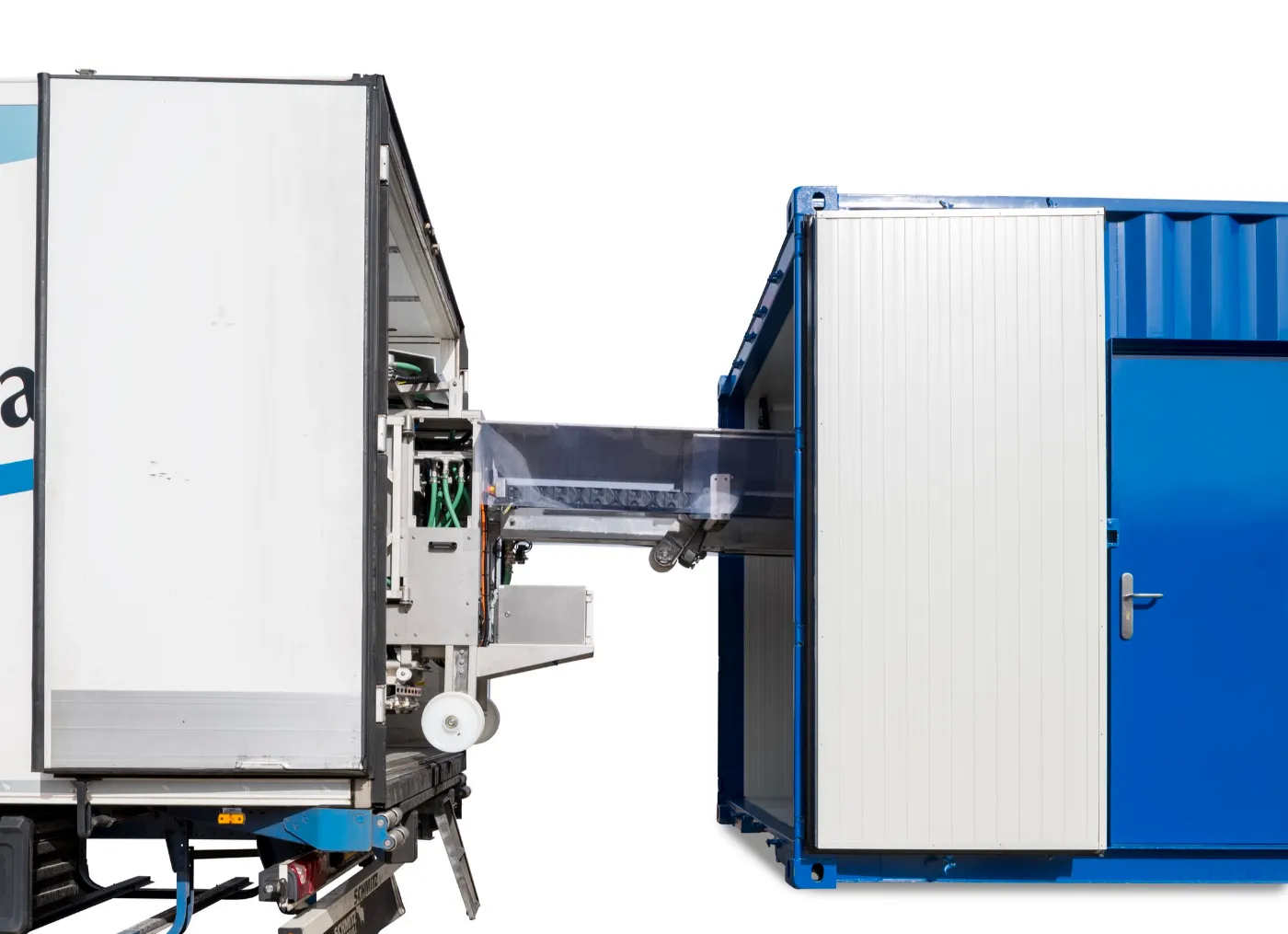
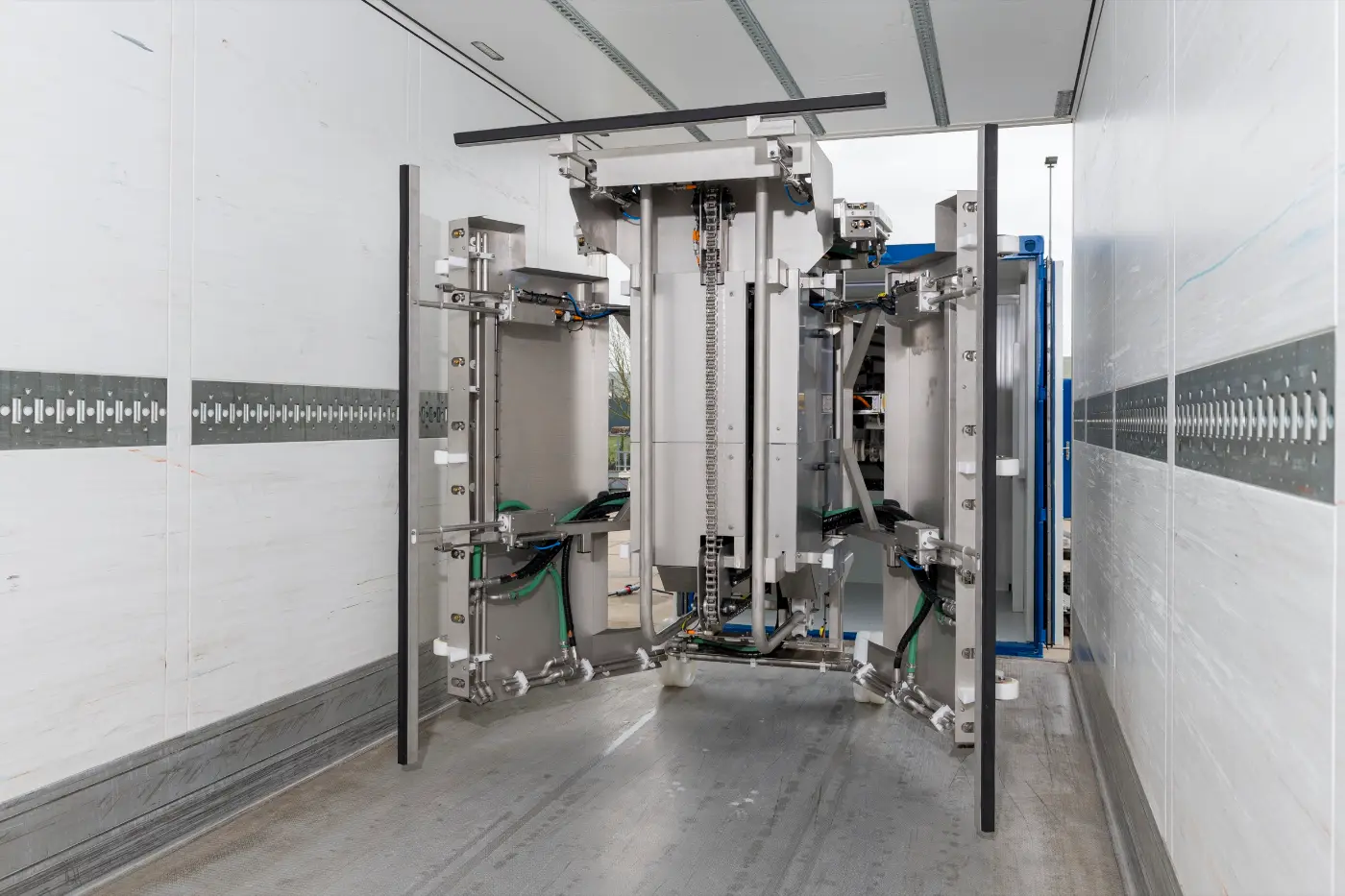
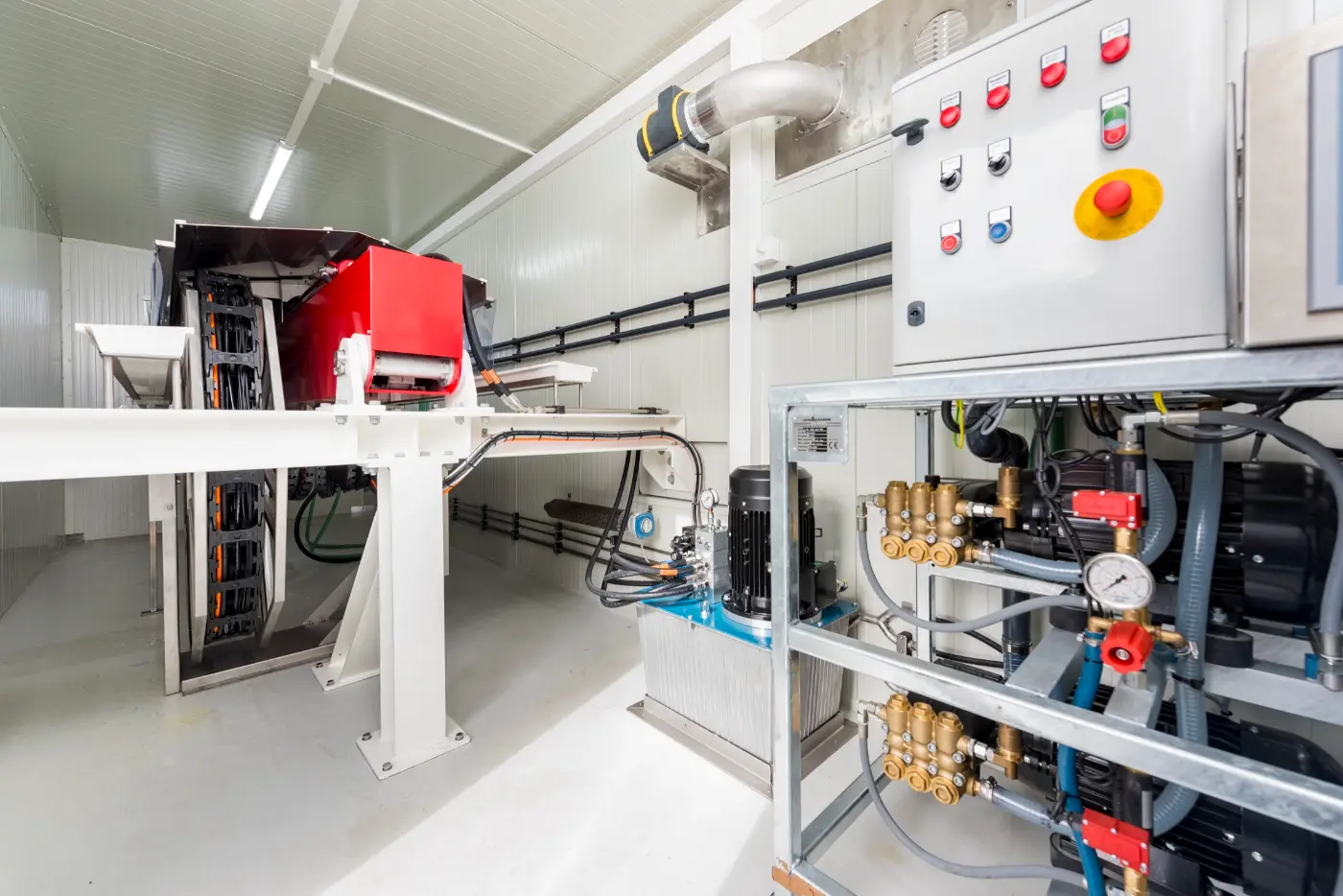
A fixed wash unit on your own yard is, at HB Nexus, a 40ft ISO container with a fully automated washing robot inside, plug and play and modular. The trailer or container docks in front of it, a telescopic arm with a rotating wash head drives the full length inside and cleans floor, walls and ceiling. Nobody enters the box and no operator stands on the wash site: the driver couples up and the machine does the rest.
Per wash that gives a fixed outcome. A full HACCP wash cycle including disinfection takes at most 15 minutes, four per hour, day and night. Every wash is registered automatically with a digital HACCP certificate via Nuvix, with registration, programme and duration, searchable in the customer portal per vehicle and date. What that certificate looks like is in our article on the HACCP certificate of an automated wash cycle. The table compares both concepts on six criteria.
Mobile truck wash
Fixed wash unit on your own yard
What gets cleaned
Mainly the outside; cargo space on request, by hand
The inside only: floor, walls and ceiling, full length
Who does the work
A washer from the provider
The robot; the driver docks himself
Planning
By appointment, when the provider is available
24/7, with no staff on site
Proof per wash
What the washer records
HACCP certificate via Nuvix, automatic
Water and chemicals
Decided per wash by the washer
Fixed dosing and contact time, 50 percent less water
Cost model
Price per wash or per vehicle, no investment
Fixed annual amount plus a cost per wash
At what volume does the choice tip to a fixed unit?
Around six vehicles per day. That comes from the logic of our ROI calculator: a fixed annual amount for the machine plus a marginal cost per wash for water, chemicals and energy, set against a wash price of 60 euros, over six wash days per week. Below that volume a provider is cheaper per wash; above it, every extra wash in your own unit costs only water, chemicals and energy.
Two things move the tipping point. A higher wash price puts it lower, a lower one higher. And proof counts: a carrier that has to produce a certificate per wash for food, pharma or chemical customers reckons with the wash price plus the hours that now go into record keeping and audit preparation. Those hours are on no invoice, but they are in your roster. The price of the unit itself is on request.
Can you combine a mobile truck wash with a fixed unit?
Yes, and for many fleets that is the outcome. The HB Nexus cleans only the inside of trailers and containers; it does not wash the outside. A mobile truck wash that does the cabs and exteriors today can keep doing that. What changes is that the cargo space no longer waits for the washer's appointment: the driver docks whenever the trailer is empty, at night too, and drives on after at most 15 minutes with a certificate.
The second combination runs through a truck wash near you that places a fixed unit itself. That is how HB Nexus came about: HB Group, founded in 2017, washes trucks at Maasvlakte and Europoort and built the machine because good people for the work inside the box get harder to find every year. What an operator needs for that is in our piece on adding interior cleaning to a truck wash. For a carrier below six per day, that is often the best route.
How do you decide in three steps?
By answering three questions with figures from your own records, in this order. The first weighs the most: is it about the outside or about the cargo space? If it stays with the outside, a mobile truck wash is the answer and there is nothing to calculate. If it is about the inside, the other two questions decide what comes next.
Count the interior cleans per day over six wash days a week, peaks included; the tipping point sits around six.
Count the customers who ask for a certificate per wash today, or will within a year.
Put both figures into the ROI calculator next to what you pay per wash now and see where the lines cross.
Below six per day with nobody asking for proof, a provider by appointment remains the logical choice. Above it, or with a large customer asking for a certificate, a demo is the quickest way to see what a 40ft unit needs on your yard in docking lane and connections; the exact values differ per set-up and come per location. You can book a demo at a time your planner can join.
Does a mobile truck wash also clean the cargo space of a trailer?
+
Some providers do it on request, with a washer who goes into the box with a lance. The result then depends on that person, and the proof on what he records. A fixed wash unit such as the HB Nexus cleans the inside only, with a fixed programme per type of load, and registers every wash automatically with a HACCP certificate via Nuvix. The outside remains work for a wash bay or a mobile washer.
Is there a minimum number of vehicles for a mobile truck wash?
+
The provider decides that, and it differs per provider and per schedule; ask beforehand, together with the price per vehicle. With a fixed unit on your own yard the question turns around: how many vehicles you have per day yourself decides whether the unit pays off. By the logic of our ROI calculator that tipping point sits around six interior cleans per day, at a wash price of 60 euros and six wash days per week.
How long does a full wash cycle take?
+
A full HACCP wash cycle including disinfection takes at most 15 minutes. That means 4 wash cycles per hour, day and night. For the comparison with a mobile truck wash, that is the difference between a wash that fits inside the trailer's turnaround and a wash that waits for the appointment with the washer. One unit can handle around 33,000 wash cycles per year.
How is the machine maintained?
+
Through a service agreement with HB Group: monthly maintenance, remote monitoring via wifi and automatic software updates. Faults can be read out remotely. That answers the objection that a fixed unit gives you an installation to look after: the maintenance sits in the agreement, and the chemicals sit in a sealed technical room that doses automatically, so nobody on site has to handle them.