Food grade trailer washout: what a proper wash must reach and prove
·6 min read·HB Nexus
People who search for a food grade trailer washout usually have a reason on the table. A new food customer wants a cleaning record per trip, an auditor asks to see the last few months, or a load of chilled produce has to go into a trailer that carried something else yesterday. Each time it comes down to one question: what has to happen inside that box, and how do you show that it happened?
What is a food grade trailer washout?
A food grade washout is not a single recipe. It is a clean of the cargo space done to the standard a food safety plan asks for. Most of those plans are built on HACCP, Hazard Analysis and Critical Control Points: a method in which a company maps the risks to food safety and records how each one is controlled. For a carrier, a clean cargo space is one of those control points. The wash counts as food grade because it follows a fixed method, suits the load and is recorded.
What that means day to day is set by your own HACCP plan or your customer's: after which loads you wash, with which product and how often. Check the current rules with the food safety authority in your country. This article is about what the wash itself has to do, whatever the plan says.
What does a food grade washout have to reach inside the trailer?
The whole interior, with no spots skipped. That sounds obvious, but in a long trailer the risk sits exactly where a hand lance reaches worst: the ceiling at the far end, the corners by the front wall and the seams in the floor. That is where food residue and moisture stay longest.
Floor: seams included, plus the corners by the front wall and the threshold at the doors.
Walls: from floor to ceiling, along the full length.
Ceiling: at the far end too, where condensation gathers.
Evenly: every square metre gets the same dosing and the same contact time.
The order never changes: clean, then disinfect, then record. Disinfecting a floor that still carries residue works poorly, because the product hits the dirt rather than the surface. That is why every proper washout starts by removing visible soiling.
Remove loose residue, so the wash reaches the surface and not the dirt.
Clean floor, walls and ceiling with a product that suits the type of load.
Disinfect with the right dosing and enough contact time.
Rinse, so no product is left behind for the next load.
Record it: which vehicle, which programme, how long, when.
For vehicles that are washed more often, such as reefers carrying fresh produce, every step weighs more, because there is less time between two loads. What that means for wash frequency is in our article on reefer washouts and why they come round more often.
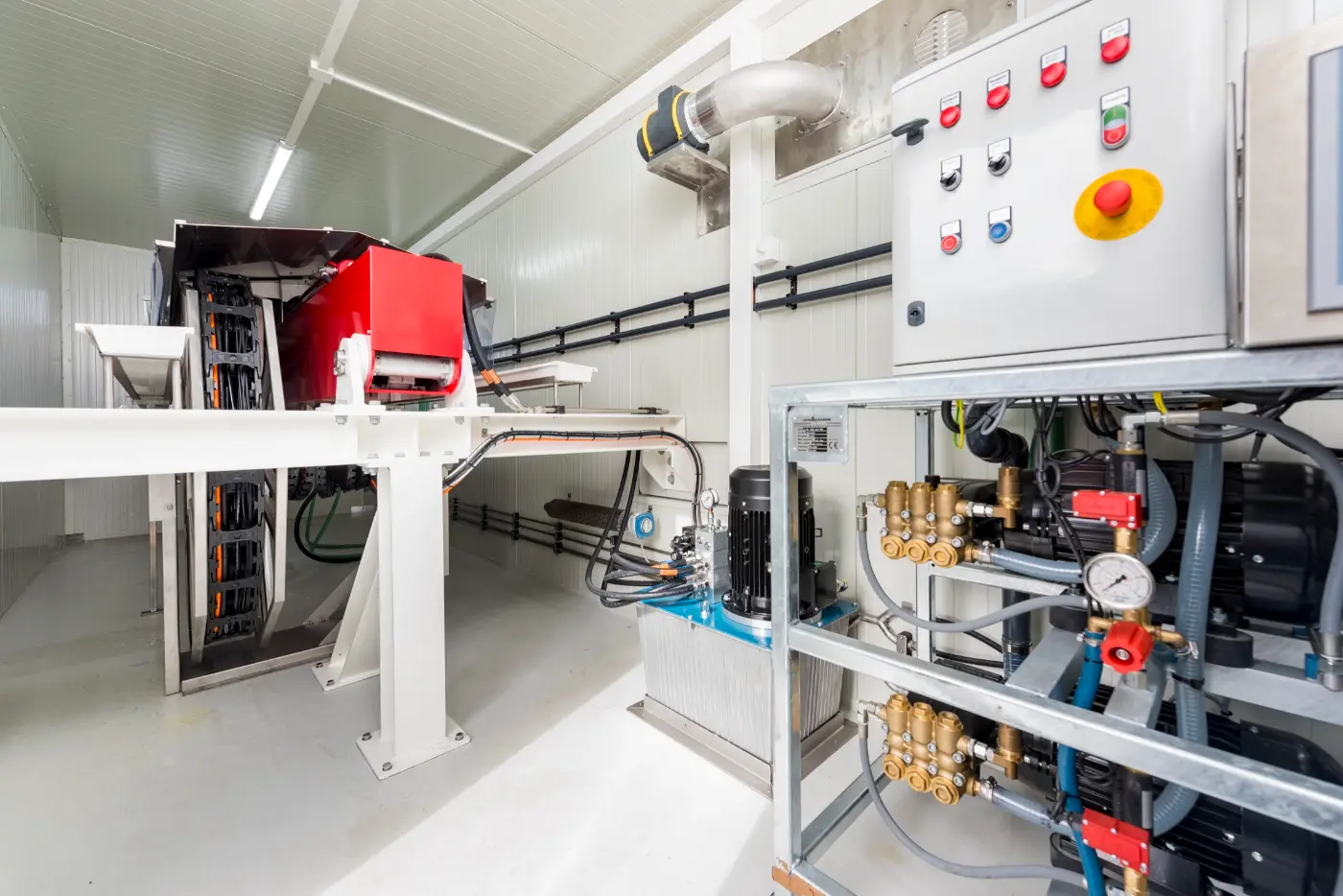
The chemicals sit in a sealed technical room and are dosed exactly for every cycle.
What must the record of a food grade washout show?
Enough to say afterwards, without debate, which vehicle was washed when and with which programme. An auditor does not look at one wash but at the series: was there a wash after every trip that needed one, and was every wash the same? A stamped card or a signature on a form says something about a person, not about what happened inside the box.
What the record shows
Why an auditor asks for it
Registration or container number
Links the wash to the vehicle that carried the load
Programme
Shows the clean matched the type of load
Duration
Shows the contact time was reached
Date and time
Shows there was a wash between two loads
Registration in a system
Makes the series searchable per vehicle and per date
We show a certificate like that in detail on the page about the Nexus HACCP certificate: registration, programme, duration and record, created automatically via Nuvix and searchable in the customer portal.
How do you make every food grade washout the same and provable?
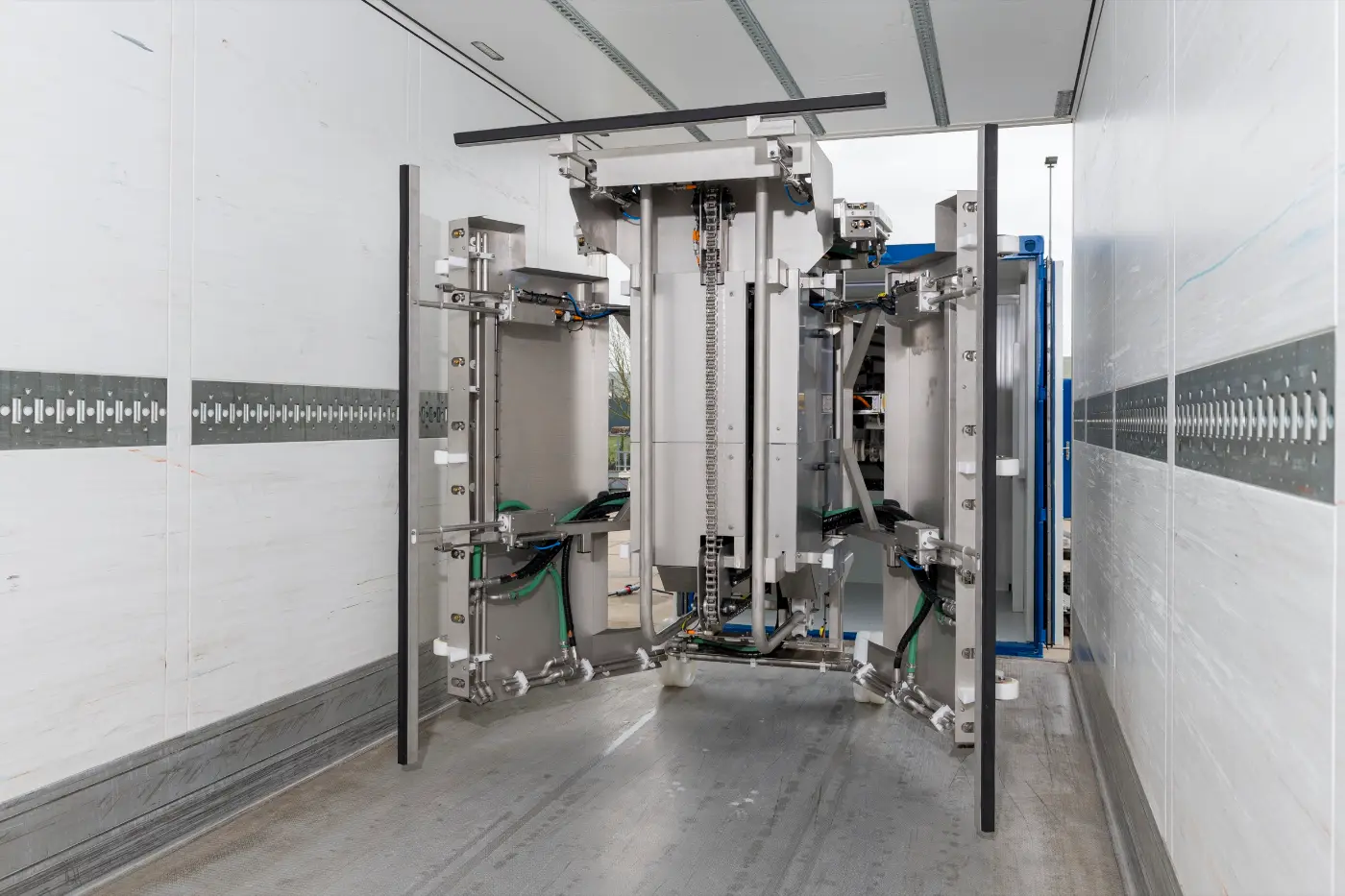
By taking the manual work out of the box. The HB Nexus is a fully automated washing robot in a 40ft ISO container. The driver docks the trailer or container himself, a telescopic arm drives the full length inside and rotating nozzles clean floor, walls and ceiling. The dosing system gives every cycle exactly the same chemicals and contact time, with a programme per type of load, from food residue to chemical residue.
A full HACCP wash cycle including disinfection takes at most 15 minutes, four per hour, day and night. Independently shown, the box is 33 percent cleaner after a Nexus wash than after manual washing, and CCD Cleaning Consultancy measured 63 percent less microbial load in November 2024. The full report is available on request.
Where can you get a food grade trailer washout done?
There are three routes. At a truck wash that offers interior washouts, you drive to the wash site and take that site's record with you. A mobile service comes to your yard by appointment. Or you wash on your own yard, with a fixed unit that is available 24/7 and records every wash itself.
Which route fits depends on your volume and on the proof your customers want to see. HB Group, founded in 2017, knows that trade-off from its own wash sites at Maasvlakte and Europoort: that is where the Nexus was built and tested, because good people for the work inside the box get harder to find every year. To see what a unit would do on your yard, you can book a demo.
How often does a trailer need a food grade washout?
+
That is set by the HACCP plan of the carrier or the customer, not by one fixed interval. It depends on the type of load, on what was in the cargo space before and on what the customer requires. With fresh and chilled produce it can be after every trip. Check the current rules for your situation with the food safety authority in your country.
What is the difference between cleaning and disinfecting?
+
Cleaning removes dirt and residue; disinfecting kills the micro-organisms left on a clean surface. The order matters: a disinfectant on a dirty floor hits the dirt rather than the surface. A food grade washout therefore always does one before the other, with the right dosing and contact time for the type of load.
How long does a food grade wash take with the Nexus?
+
A full HACCP wash cycle including disinfection takes at most 15 minutes. That means four wash cycles per hour, day and night, and one unit can handle around 33,000 wash cycles per year. The driver docks himself; no operator or training is needed on the wash site.
Do I get a HACCP certificate after every wash?
+
Yes. Every Nexus wash automatically produces a digital HACCP certificate via Nuvix, showing among other things the registration, programme and duration. All certificates are searchable in the customer portal, per vehicle and per date. Audit preparation becomes a search instead of a folder full of forms.