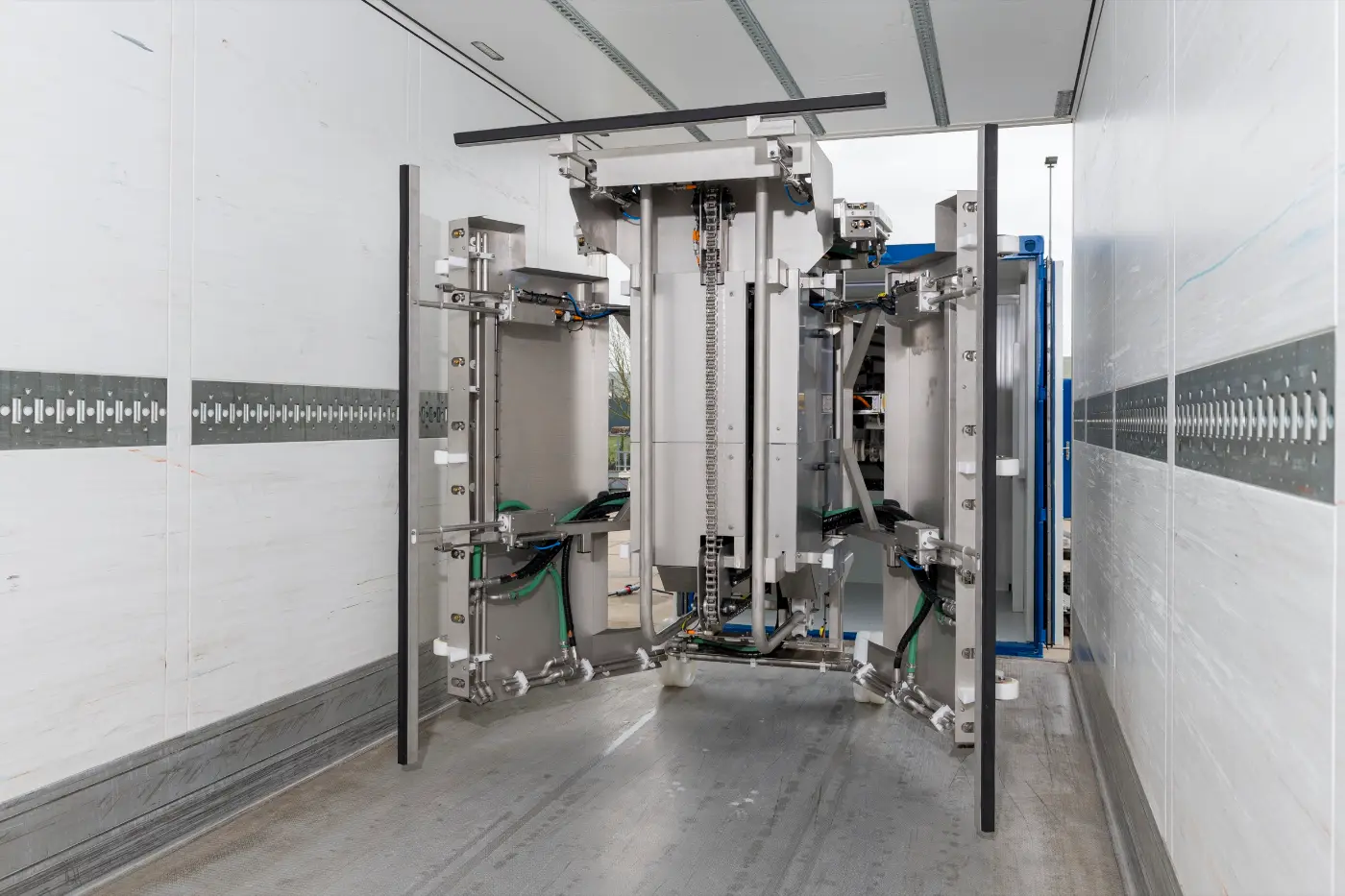
Anyone running reefers for food knows the pattern. Frozen today, chilled meat tomorrow, dairy the day after. Every change leaves something behind, and every food customer wants proof the trailer was clean before loading. This piece explains why a refrigerated trailer needs more washouts than a dry van, what a washout must reach, what proof it should leave, and why a lance rarely delivers the same result twice.
Why does a reefer need a washout more often than a dry van?
Because a reefer carries food in a closed, cold space that holds moisture. A reefer carries meat, fish, dairy, vegetables and frozen goods, often in rotation, and each load type leaves something different: protein from meat, sugars from fruit, the smell of fish.
Then there is the climate. Every time the doors open, warm air condenses on the cold walls and floor. That condensation sits in the floor grooves and the seams at the door, exactly where residue collects too. In a dry van it dries out. In a reefer it stays damp until the next washout.
For a food customer, three things are a risk: allergens from a previous load, odour carrying over, and microbes that survive in a damp, cold space. That makes a change of load type the main trigger for a reefer trailer cleaning. What food, pharma and chemicals demand as evidence is covered in our article on trailer interior cleaning for food, pharma and chemicals.
What does a reefer washout have to reach?
A reefer washout has to cover floor, walls and ceiling over the full length of the cargo space, including the corners, the seams and the grooves in the floor. Anything less is a rinse. A rinse moves dirt, a wash removes it. The ceiling is the part most often skipped, because it is high up and does not look dirty, while that is exactly where condensation settles and drips down onto the next load.
The floor, including the grooves and the seam at the door
The walls over the full length, into the front corners
The ceiling, where condensation settles
A fixed dose and contact time for the chemicals
The chemicals follow the type of load. A programme for food residues is not the same as a programme for chemical residues, and dose and contact time have to be identical from one washout to the next. Otherwise the result is not reproducible, and so not provable to a food customer.
Why does a manual reefer washout vary from wash to wash?
A manual reefer washout varies from wash to wash because the quality depends on the person, the moment and the time available. A washer who reaches the front corners of a thirteen metre trailer at the start of a shift may not at the end of a busy day. The ceiling means an arm held up and a wet face, so the lance passes there quickest.
Chemicals are the second difference. With manual work the washer decides dose and contact time, and both shift with the workload. Too short a contact time is the difference between clean and clean-looking, and you only notice it at the customer.
This work is heavy, wet and cold, and good people for it get harder to find every year. That is why HB Group built the Nexus. In the independent CCD Cleaning Consultancy test (November 2024), the microbial load after a Nexus wash was 63 percent lower; the result is 33 percent cleaner than manual washing.
How does an automated reefer washout work?
An automated reefer washout in the HB Nexus takes at most 15 minutes, disinfection and certificate included, and nobody enters the trailer. The driver docks at the 40ft ISO container, collision protection and sensors watch the docking, and the telescopic arm drives the rotating wash head the full length inside, every cycle the same. The steps are on the page how it works.
Step
What happens
Who does it
1. Docking
The trailer docks at the Nexus; collision protection and sensors watch the process
The driver
2. Robot wash
The wash head drives inside and cleans floor, walls and ceiling to the chosen programme, with automatic dosing and fixed contact time
The machine
3. Certificate
The wash is registered with a HACCP certificate through Nuvix, per vehicle and per date
Nuvix
Total
At most 15 minutes, 4 wash cycles per hour, day and night
No staff
You choose the programme per type of load. The dosing system keeps dose and contact time identical every cycle. Because the machine runs 24/7 without staff, the washout fits between two trips instead of waiting for a washer to be free. One unit can handle around 33,000 wash cycles per year, with 50 percent less water per wash.
What proof do you get after a reefer washout?
After a reefer washout in the Nexus you automatically get a digital HACCP certificate per wash through Nuvix. It shows the registration, the programme that ran and the duration of the wash. All certificates are searchable in the customer portal, per vehicle and per date, so an audit does not start with a hunt for slips. What it records is on the page about the HACCP certificate.
Many shippers ask for a washout ticket before they load. A food customer wants more than a ticket: which programme ran, for how long and when, per trailer. The difference between a washout ticket and a certificate per wash is shown in our piece on what a HACCP certificate of an automated wash looks like.
How often should a reefer trailer be washed out?
How often a reefer trailer is washed out is set by your own HACCP plan, not by a machine builder. That plan names the hazards per load type and records when a washout is required: at a change of load type, after allergens, after a leak, or at a fixed interval. We give no number: it differs per company and per load, and a supplier's number is worth nothing in an audit.
What applies to everyone: the more often the plan prescribes a washout, the more it matters that every washout is identical and on record. A plan that asks for one at every change of load type only holds up if that washout takes a quarter of an hour and nobody waits for it.
What does this mean for a truck wash or a carrier in food?
That the question shifts from who washes out the reefer to how many washouts per day you can handle and prove. A reefer fleet that needs a washout at every change of load type soon reaches a daily number manual work cannot match, least of all at night. The calculator model works with six wash days per week, a fixed annual amount for the machine and a marginal cost per wash; at 60 euros per wash the tipping point is around six vehicles per day. Enter your own numbers in the ROI calculator.
The machine price is on request and the technical specifications differ per set-up. To see a washout run before you decide anything, you can book a demo.
At a wash bay you pay per washout, often with extra charges for ceilings, debris, pallets or sanitising, and tariffs differ per site, so we quote none. With your own unit the sum is different: a fixed annual amount for the machine plus a marginal cost per wash. At 60 euros per wash the tipping point is around six vehicles per day; enter your own numbers in the ROI calculator.
How do I wash out a reefer trailer properly?
+
Reach everything: the ceiling, the walls over the full length into the front corners, and the floor with its grooves and the seam at the door, with a fixed dose and contact time for the chemicals. Done by hand that takes a lance, a ladder and a wet face. In the HB Nexus the telescopic arm covers floor, walls and ceiling in one movement, the same way every cycle.
Is a quick hose-down enough for a reefer?
+
No. A hose-down moves loose dirt but leaves protein, fat and odour in the floor grooves and the seams, and usually never reaches the ceiling. Without a fixed dose and contact time for the chemicals, the result is not reproducible and therefore not demonstrable. For a food load that is exactly the problem a customer does not want.
Can a reefer be washed out without anyone entering the trailer?
+
Yes. In the HB Nexus the driver docks the trailer at the container and the telescopic arm drives the rotating wash head the full length inside. Floor, walls and ceiling are cleaned in the same cycle, with the programme that matches the type of load. Nobody enters the cargo space, no operator is needed and the machine runs 24/7.