Anyone running a truck wash knows the self-service bay: the driver pulls in, picks up the wand and washes the truck himself, with nobody from the site standing by. For the inside of a trailer or container that option never existed: someone always walked in with a lance, and that is the work you can no longer find people for. HB Group ran into the same thing on the Maasvlakte and in Europoort and built a machine that turns the interior wash into a self-service lane. Here is one such wash cycle, step by step.
What does the driver do at a self service truck wash for trailer interiors?
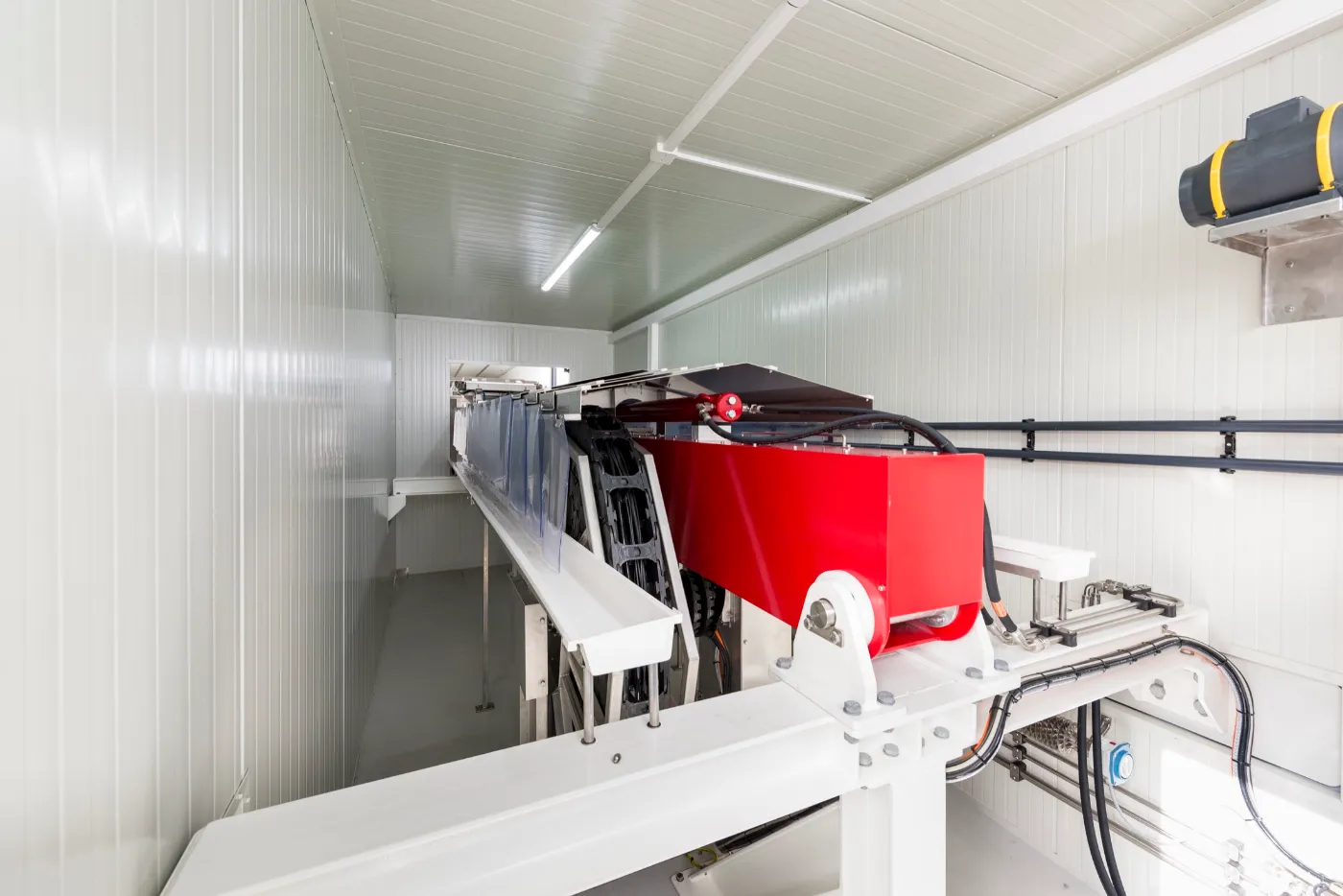
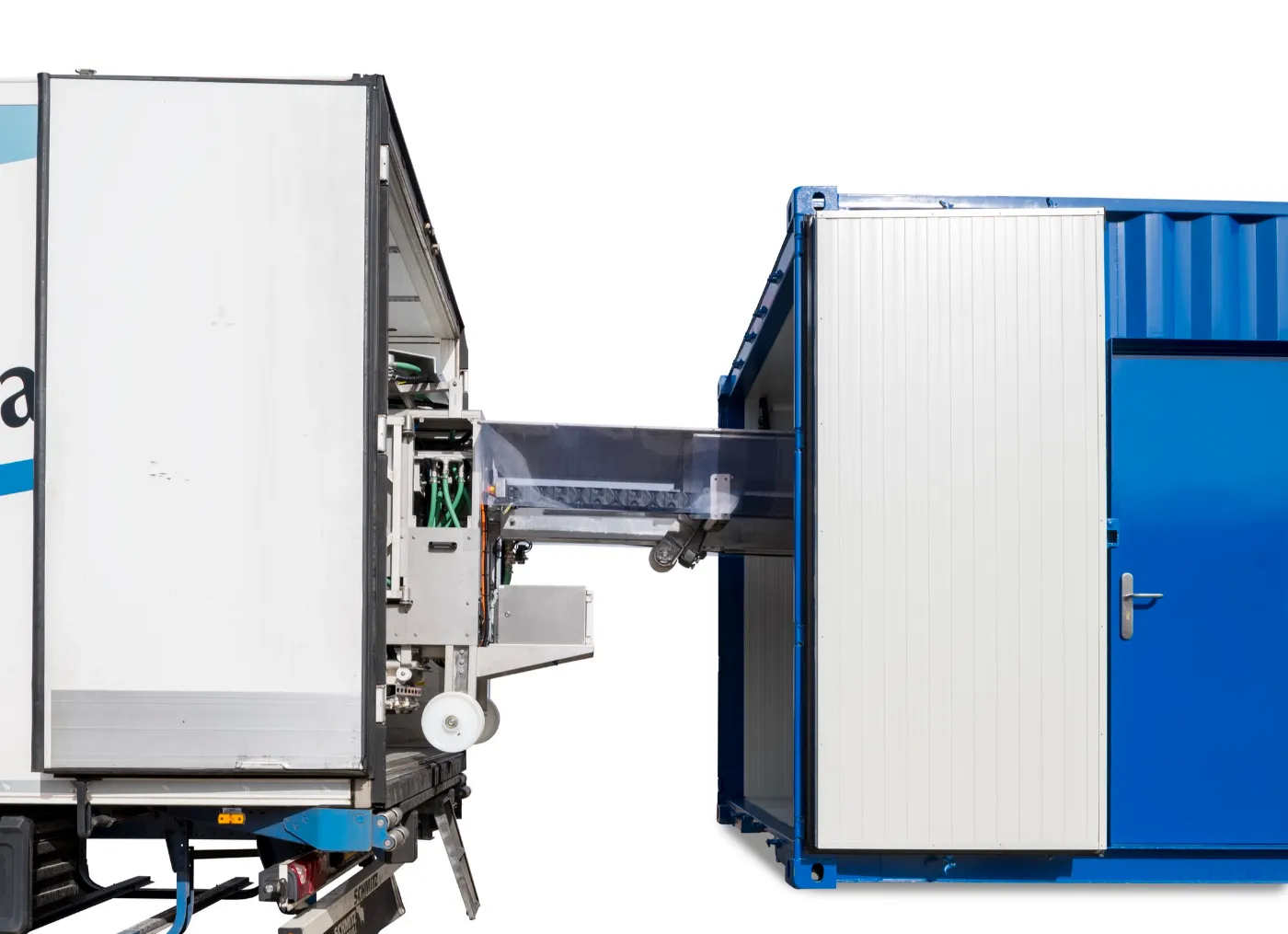
The driver docks and does nothing else. At the HB Nexus the driver reverses the trailer or container up to the installation, a 40ft ISO container with the robot arm inside. Collision protection and sensors watch the docking so that machine and vehicle never touch. Once coupled, the fully automatic control takes over. The self-service part is the docking itself; no wand, no button.
Next, the telescopic arm drives the full length of the cargo space. Its rotating wash head cleans floor, walls and ceiling according to the programme that matches the type of load, and a full HACCP wash cycle including disinfection takes a maximum of 15 minutes. In pictures, those steps are on the how it works page. Meanwhile the driver waits by the cab; then he uncouples and drives off, no chemicals touched.
Step
Who does it
What happens
1. Docking
The driver
The trailer or container docks; collision protection and sensors watch the process
2. Robot wash
The robot
The wash head drives inside and cleans floor, walls and ceiling, with no manual work
3. Certificate
Nuvix, automatically
Every wash cycle is registered with a HACCP certificate
Supervision on the lane
Nobody
No operator and nothing to operate
What does self-service mean for staffing your truck wash?
On the lane itself: nobody, just as at a self-service bay for the outside. That is the whole point of an unattended truck wash for trailers. No operator starts the machine, no washer walks in with a lance and nobody checks the corners afterwards. The HB Nexus is available 24/7 without staff, and one unit can handle around 33,000 wash cycles per year.
What remains is not on the lane but around it. Someone in your organisation plans the wash cycles in Nuvix, which also handles registration and invoicing, and looks at the certificates in the customer portal. Maintenance and monitoring of the machine run under the service agreement with HB Group, so those hours are not yours to staff. What it takes to put such a lane next to an existing wash is in our article on adding interior cleaning to a truck wash.
We give no headcounts or wage figures: they differ per site. What holds everywhere: the shift you cannot fill today no longer needs filling tomorrow.
Does a driver need to learn how the wash works?
No. The HB Nexus needs no training to operate, because there is nothing to operate on the lane. Coupling up is the driver's only job, the machine does the rest. The programmes per type of load are preset in the fully automatic control, so a trailer with food residues gets a different programme from a container with chemical residues, without anyone on site having to choose.
That is a real difference from a self-service bay, where the result depends on the driver, and from manual washing, where it varies per shift and per washer. With the Nexus every wash cycle is identical, because the programme is fixed and the arm follows the same path every time. CCD Cleaning Consultancy tested that independently in November 2024: after a Nexus wash cycle the microbial load in the box was 63 percent lower.
Who handles the chemicals when there is no operator?
The machine does. Inside the container the chemicals sit in a sealed technical room and are dosed automatically every cycle. The dosing system controls the exact quantity and the contact time, identically on every wash. So there is no jerrycan on the lane, nobody mixes anything and nobody has to read a safety data sheet. Which chemicals and which contact time a load requires is fixed in the programme per type of load.
On a manual wash site the chemicals come up with every new employee: which dilution, which contact time, which gloves. At the Nexus those questions are answered once in the programme and stay the same for every wash cycle, day or night.
How does an unattended truck wash stay safe when nobody is watching?
By keeping machine, vehicle and people structurally apart. Collision protection with sensors watches the docking and the whole cycle, and nobody enters the box any more: the robot does the work. The wet, slippery and chemical workplace of manual interior cleaning does not exist on a Nexus lane. Hence the Nexus hygiene figure of 99 percent fewer claims and accidents. Why nobody has to enter the cargo space any more is set out in our article on the cargo space.
The sensors do more than prevent a collision. They watch the whole process, from docking until the arm is back inside. Meanwhile the driver stands by the cab and the technical room with pumps, chemicals and controls stays closed.
Does a self service truck wash really run 24/7, even with a fault?
Yes. The HB Nexus is designed for continuous operation and runs day and night, even when your office is closed. Keeping a 24/7 trailer washout open is, on this lane, a planning question rather than a staffing question. A fault is read out remotely: the service agreement with HB Group covers monthly maintenance, remote monitoring via wifi and automatic software updates, so nobody has to drive to the site first.
For you that means no technician of your own for the machine and no fault rota to staff. What a site returns when the machine runs six wash days a week, you work through in the ROI calculator. Every certificate sits in the customer portal per vehicle and per date, so audit preparation is no longer evening work.
Why did wash operators build a self-service truck wash for trailer interiors themselves?
Because they could no longer find the people. HB Group, founded in 2017, washed trucks itself for years at HB Truckwash on the Maasvlakte and in Europoort. Cleaning the inside of trailers and containers is heavy, wet and unhealthy work, and finding good people for it got harder every year. So they built the solution themselves: first ECO Containerwash, then the fully robotic Nexus and the Nuvix software that plans, registers and invoices every wash cycle. Developed, tested and built in the Netherlands, with thousands of wash cycles a year on their own sites as testing ground. The full story is on the about us page.
To see such a self-service wash cycle in practice, you can book a demo. You see for yourself how the driver docks and how the certificate arrives.
How does a self service truck wash for the inside of a trailer work?
+
In three steps. The driver docks the trailer or container at the Nexus, with collision protection and sensors watching the process. Next the wash head drives inside and cleans floor, walls and ceiling according to the programme for that type of load, in a maximum of 15 minutes. Finally the wash cycle is registered automatically with a HACCP certificate through Nuvix. A driver arriving for the first time only needs to know where to dock.
How much does a self service truck wash for trailer interiors cost?
+
The price of the machine is on request. What is known is the cost model: you work with a fixed annual amount for the installation plus a marginal cost per wash, with no staff on the lane. At a rate of 60 euros per wash the tipping point is around six vehicles a day. In the ROI calculator you enter your own numbers and see what a lane on your site returns.
Can the lane stay open 24 hours a day without staff?
+
Yes, the Nexus is designed for continuous operation. One unit can handle around 33,000 wash cycles per year. Because no operator is needed, a night shift or weekend shift stops being a staffing question and becomes a planning question: the wash cycles are scheduled through Nuvix and the machine works through them, even when your office is closed.
What happens if the robot has a fault while nobody is there?
+
The fault is readable remotely. Under the service agreement with HB Group the machine is monitored remotely via wifi, receives automatic software updates and gets monthly maintenance. So you do not have to send a technician of your own to the wash site to see what is going on: HB Group reads out the fault.