Anyone who wants to start a truck wash gets the same question back from banks, equipment suppliers and franchisors: how many washes a day will you run? For trailer washouts the answer has two numbers that belong to the machine and the cost model, and one that only you can give: how many trailers pass your site. This article puts ceiling, floor and wash window side by side.
What is the ceiling: how many washes per hour does a wash unit manage?
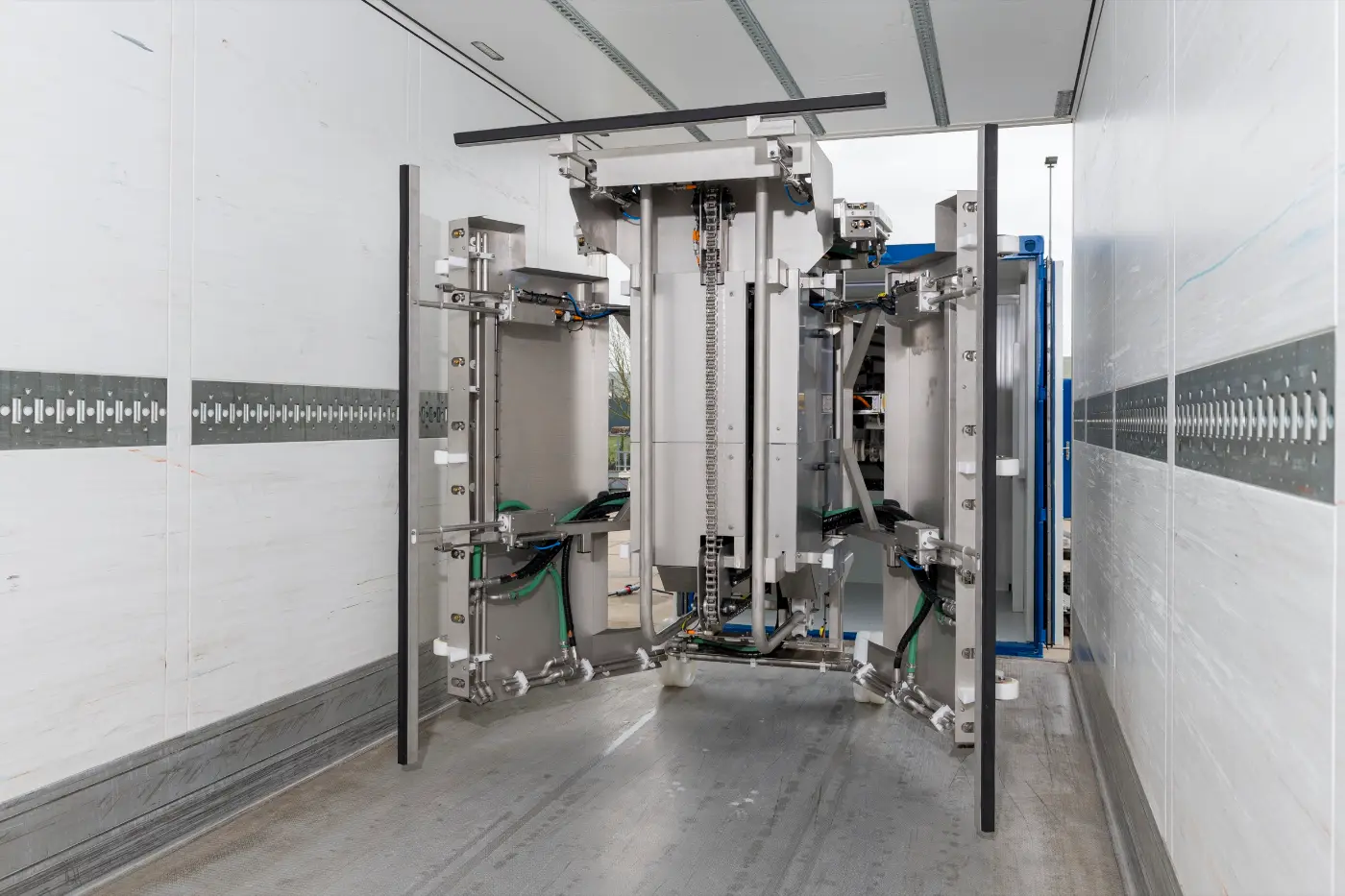
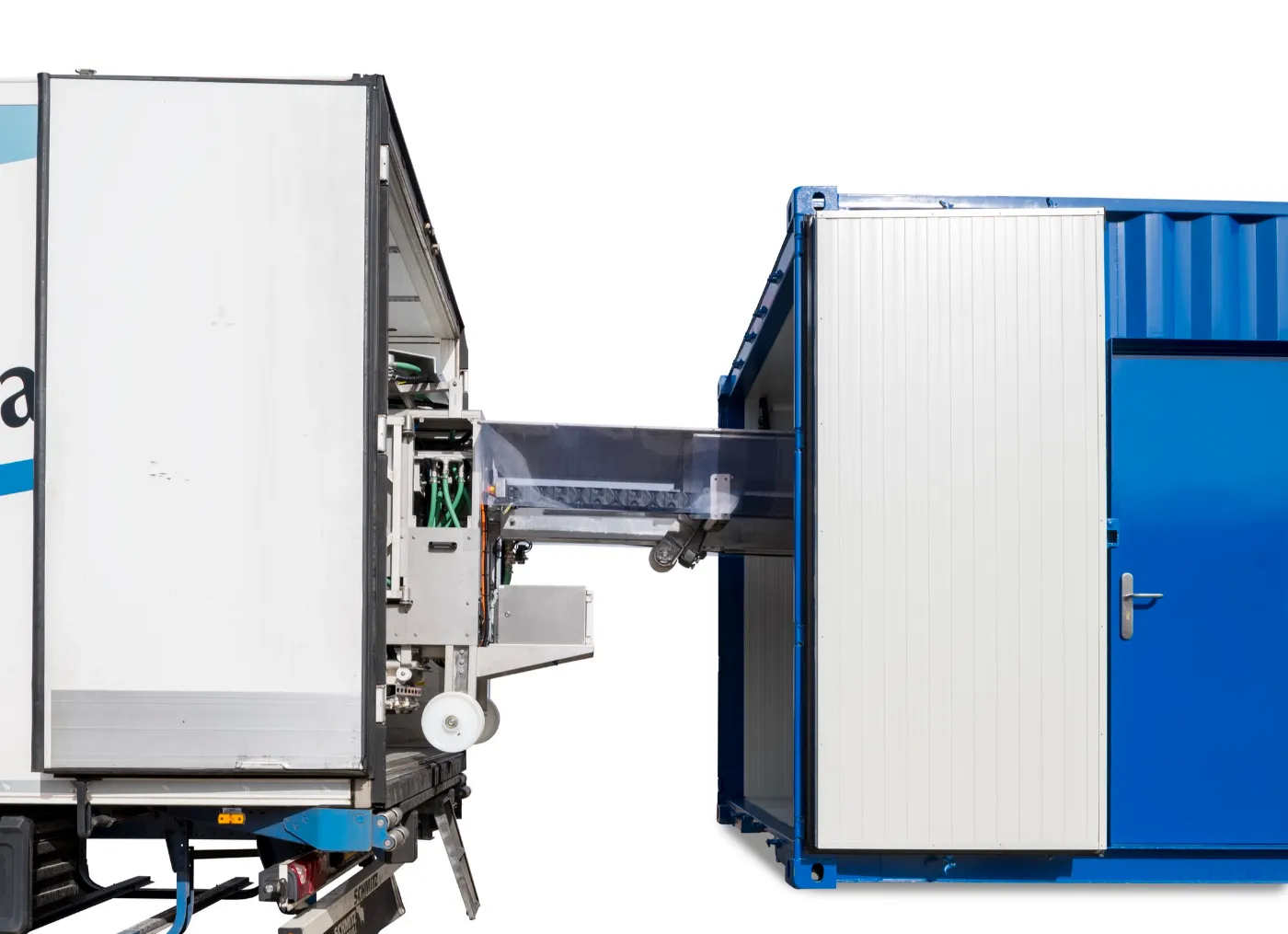
Four an hour, and that figure does not move with how busy you are. A full HACCP wash cycle in the HB Nexus takes at most 15 minutes, including disinfection and the certificate that is registered automatically at the end. In that time the trailer docks, the telescopic arm drives the wash head in along the full length, floor, walls and ceiling are covered, the chemicals are dosed with a fixed contact time, and the arm withdraws for the next trailer.
For a starter this is the ceiling of the plan. The programme for each type of load is the same every cycle, so the duration is the same every cycle, and you know in advance the most an hour can yield. Running day and night, that comes to around 33,000 wash cycles a year. One unit sells no more than that; anything you write into the business plan above it calls for a second container.
How many trucks per day does a truck wash need to be profitable?
Around six a day, at 60 euros per wash. That is the floor of the plan and it comes from the model behind our calculator: a fixed annual amount for the machine, a marginal cost per wash and six wash days a week. Below the tipping point you pay for the machine; above it the machine pays for itself. How that model is built is covered in our article on what manual trailer cleaning really costs, worked through from the cost side.
Between floor and ceiling sits your wash window: the number of hours in a day when a trailer is ready to dock. The table works that through for a few common windows, on the assumption that the next trailer is waiting when the previous one uncouples. A twenty minute gap between two trailers is lost capacity, however fast the machine is.
Wash window per day
Wash cycles
Where this fits
8 hours (one shift)
32
Own fleet returning during the day
12 hours
48
Truck wash with evening opening
16 hours (two shifts)
64
Depot with a morning and an evening peak
24 hours
96
Continuous operation, night slots for regular customers
How does a starter plan for peaks and night slots?
Start with the hour in which most trailers arrive together, not with the daily average. A fleet of forty trailers that returns between four and six in the afternoon needs twenty washes an hour in that window. No single unit manages that, whatever its cycle time. The answer is to move washes into the hours when the unit would otherwise stand idle, and that is exactly what the HB Nexus is built for.
Those idle hours exist, because the machine runs 24/7 without staff. The driver couples the trailer, collision protection and sensors watch the docking, and nobody needs to be at the wash bay. A trailer that comes in at eleven at night can be washed at eleven at night instead of joining the queue the next morning. How a wash cycle runs from docking to certificate is shown on the how it works page.
Count, for one week, how many trailers arrive at your intended customers in each hour.
Set four wash cycles per hour against that and mark the hours where demand is higher.
Decide which trailers can wait until the night and which must be clean for the next trip.
Check the approach route: a washed trailer must be able to leave without blocking the next one.
Starting as a franchise or with your own wash unit: what is the difference?
A franchise gives a starter a brand, a proven set-up and help with site and marketing; your own wash unit puts the installation, the planning and the certificate data in your own hands. The two do not rule each other out. The HB Nexus sits in a 40ft ISO container, is plug and play and modular, and stands just as well next to an existing wash line under a franchise banner as on your own yard. What the washout does change is what you sell: a demonstrably clean cargo space with a HACCP certificate for every wash, rather than a clean exterior.
That is also the route HB Group took: founded in 2017 as a truck wash operator, with HB Truckwash at the Maasvlakte and Europoort as the proving ground for thousands of washes a year, then a machine builder. What adding interior cleaning to an existing wash line asks and returns is in our piece on adding interior cleaning to a truck wash. Start with one unit and a second one later is a second container next to the first, not a rebuild.
How many staff does a truck wash with a wash robot need?
Nobody at the wash bay. The driver couples the trailer and the machine does the rest; there is no operator and no training needed. For a starter that rewrites the staffing plan: the wash itself needs no shift roster, so the hours you do plan go to customers, planning and the yard. The chemicals sit in a sealed technical room and are dosed automatically, so nobody is standing in a wet, slippery workplace either.
Maintenance is something you buy rather than roster: the service agreement with HB Group covers monthly maintenance, remote monitoring over wifi and automatic software updates, and faults can be read out remotely. And the wash is demonstrably cleaner: 33 percent cleaner than manual washing, independently tested, with 63 percent lower microbial load according to CCD Cleaning Consultancy in November 2024.
How do you handle planning and invoicing from day one?
Nuvix is the software that belongs with the HB Nexus and it does four things: planning, registration, invoicing and a customer portal. For a starter that means no separate accounting package, planning board and certificate folder. The wash window from the table becomes a roster with fifteen minute slots, every wash cycle is registered automatically with a HACCP certificate, searchable per vehicle and per date, and invoiced from the same software. What exactly is recorded per wash cycle is in our article on what Nuvix records for every wash cycle.
If you want to know whether your site lands above the floor and below the ceiling, we work it through in a demo on site, with your own numbers and your own wash window. Bring your count per hour; that is the one figure we cannot fill in for you.
How many trucks per day does a truck wash need to be profitable?
+
In the HB Nexus model the tipping point at 60 euros per wash sits at around six vehicles per day, on six wash days a week. That is a model input, not a tariff: put in your own price and volumes and the point shifts. Above six the unit pays for itself, with four wash cycles an hour as the ceiling.
Can a truck wash run 24/7 without staff?
+
Yes, the Nexus is designed for continuous operation. One unit can handle around 33,000 wash cycles per year. Because no operator is needed and the driver couples the trailer, you can use night slots for regular customers and keep the daytime hours free for peaks or for passing drivers who need a certificate.
How many staff do I need for a truck wash with trailer washouts?
+
No operation at the wash bay. The driver couples the trailer and the machine does the rest, at night too. No training is needed. The chemicals sit in a sealed technical room and are dosed automatically, and maintenance runs through the service agreement with HB Group: monthly maintenance, remote monitoring and automatic software updates.
Can I add trailer washouts to an existing truck wash?
+
Yes. The HB Nexus is a 40ft ISO container that is placed plug and play next to an existing wash line, so you build no hall and you do not stop your exterior wash. The driver docks, the robot cleans the cargo space and Nuvix registers the certificate. Connection values differ per set-up and are supplied per location.